
As Ontario’s largest union solely representing health-care workers, we’ve travelled across the province to hear directly from OHaH staff about the issues that matter most: wages, dues, bargaining, and the forced return-to-office mandate.
Here are the facts to help you make an informed decision.
ONA leads in wages across most major OHaH job classifications and ranks among the highest in Ontario health care.
We’ve secured top wages for Care Coordinators, Schedulers, Team Assistants, RPNs, and Nurse Practitioners through experience, focus, and proven bargaining power.
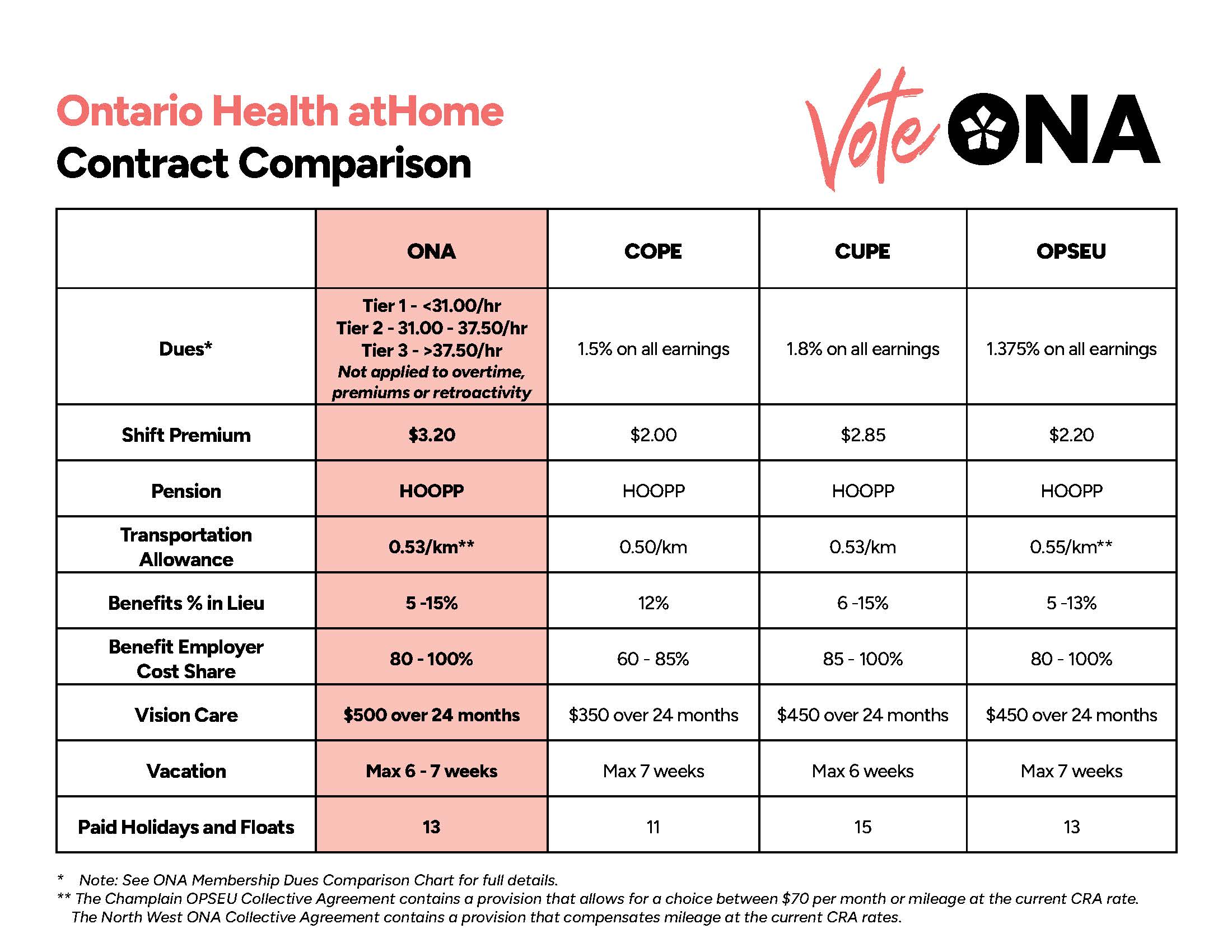
Contract Comparison
ONA dues are flat and predictable. Overtime, extra shifts, or premiums won’t increase your ONA dues. With percentage-based dues that the other unions have, every extra dollar you earn means more taken off your pay.
Our dues include legal support, liability insurance, critical illness and long-term disability coverage: no extra or hidden fees.
Members vote on the dues structure and any increases.
ONA dues are nearly 100 per cent tax deductible, meaning you can claim them and receive a portion back at year end.
At ONA, members set bargaining priorities – regardless of job or status – and have many direct opportunities to shape bargaining. Our goal is to raise Ontario Health atHome wages and working conditions to the highest standards and then push for even better. ONA has never lost ground in provincial bargaining; we only win gains.
At ONA, the Board of Directors does not determine the bargaining priorities – You do! ONA’s process is unique and ensures member involvement in every step of the way.
The RTO policy is unnecessary, and it is applied unequally across branches. ONA is the first union to secure a mediation date on April 27.
ONA has won accommodation agreements for members who are unable to comply for Human Rights Code-related reasons and negotiated agreements for some workers to return to alternate offices closer to home.
ONA Statement: ONA Statement on Government’s Mandatory Return-to-Office Directive • Ontario Nurses' Association
ONA gets results. We have a long history of winning improvements through collective bargaining and actions, including:
Unlike in other unions with a non-health care focus, your voice won’t get lost in ONA. Instead, you set the direction of our campaigns and lobbying efforts to improve wages, working conditions, and health care because it is our specialty.
ONA is the largest health-care union in Ontario, with 68,000+ members and 18,000 nursing students. That strength means your voice is heard at the workplace, in the media, and at Queen’s Park. As an ONA member, you also get access to a wide range of supports and services, all part of your membership without added fees like other unions:
On the dates listed below, unless “Virtual” is indicated, you can attend “In-Person” information sessions to hear directly from an ONA member of the Board of Directors about what it means to be a member. Ask questions and learn more about why you should vote ONA.
All in-person information sessions will be held at 9 a.m., 10:30 a.m., 1:30 p.m. and 3 p.m., and you must sign up with your manager. Virtual sessions will be held at 1:30 p.m. on the Ontario Health atHome Teams App, and again you must sign up with your manager. View the schedule for your region below.
| Office | Address | Meeting Room | Date |
|---|---|---|---|
| Sheppard | 45 Sheppard Avenue East, North York, ON M2N 5W9 Suites 600 & 700 | North York Room – 7th floor | Jan 30 |
| Newmarket | 1100 Gorham Street, Newmarket, ON L3Y 8Y8, Units 1-9 | Aurora, Bradford & Georgina | Jan 30 |
| Markham | 11 Allstate Parkway, Markham, ON L3R 9T8, Suites 450, 470 & 500 | Central Park | Feb 9 |
| Office | Address | Meeting Room | Date |
|---|---|---|---|
| Whitby | 920 Champlain Court Whitby, ON L1N 6K9 | Ajax-Pickering | Jan 30 |
| Scarborough | 100 Consilium Place, Scarborough, ON M1H 3E3, Suites 801 & 900 | Markham & McCowan | Jan 30 |
| Peterborough | 700 Clonsilla Avenue, Peterborough, ON K9J 5Y3, Suite 202 | Parr Trail Room | Jan 30 |
| Lindsay | 370 Kent Street West, Lindsay, ON K9V 6G8, Unit 11 | Angeline Room | Feb 9 |
| Campbellford | 119 Isabella Street, Campbellford, ON K0L 1L0, Unit 7 | Trent Room | Feb 6 |
| Haliburton | 73 Victoria Street, Haliburton, ON K0M 1S0 | Boardroom | Feb 6 |
| Port Hope | 151 A Rose Glen Road, Port Hope, ON L1A 3V6 | Wellington Room | Feb 6 |
| Office | Address | Meeting Room | Date |
|---|---|---|---|
| Brampton | 199 County Court Boulevard, Brampton, ON L6W 4P3 | Brampton, Caledon & Dufferin | Jan 29 |
| Office | Address | Meeting Room | Date |
|---|---|---|---|
| Renfrew | 850 O'Brien Road, Renfrew, ON K7V 0B4, Unit 8 | Meeting Room 1 | Feb 4 |
| Pembroke | 1100 Pembroke Street East, Pembroke, ON K8A 6Y7 | Meeting Room A | Feb 4 |
| Cornwall | 709 Cotton Mill Street, Cornwall, ON K6H 7K7 | Meeting Room 1 | Feb 5 |
| Hawkesbury | 119 Main Street East, Hawkesbury, ON K6A 1A1, Suite 101 | Meeting Room 1 | Feb 5 |
| Winchester | 530 Fred Street, Winchester OnK0C 2K0 | Meeting Room 2 | Feb 5 |
| Labelle | 4200 Labelle Street, Ottawa, ON K1J 1J8 Suite 100 | Rooms C, D & E | Feb 6 |
| Moodie | 301 Moodie Drive, Nepean, ON K2H 9C4 Suite 105 | Room 1 & 2 | Feb 9 |
| Office | Address | Meeting Room | Date |
|---|---|---|---|
| Chatham | 180 Riverview Drive, Chatham, ON N7M 5Z8 | Lake Erie | Jan 23 |
| Windsor | 5415 Tecumseh Road East, Windsor, ON N8T 1C5 | Nellie McClung | Jan 23 |
| Sarnia | 1150 Pontiac Drive, Sarnia, ON N7S 3A7 | Canatara/Rock Glen room | Jan 23 |
| Office | Address | Meeting Room | Date |
|---|---|---|---|
| Hamilton | 211 Pritchard Road, Hamilton, ON L8J 0G5 | Albion Falls, Webster Falls, Chedoke Falls & Sydenham Falls | Jan 27 |
| Niagara | 149 Hartzel Road, St. Catharines, ON L2P 1N6 | Escarpment | Jan 27 |
| Burlington | 440 Elizabeth Street, Burlington, ON L7R 2M1 | Birch/Balsam Open as one | Jan 28 |
| Brantford | 195 Henry Street, Brantford, ON N3S 7Y3, Bldg. 4, Unit 4 | Oneida/Mohawk Open as one | Jan 28 |
| Office | Address | Meeting Room | Date |
|---|---|---|---|
| Mississauga | 2655 North Sheridan Way, Mississauga, ON L5K 2P8, Suite 140 | Rooms 1, 2 & 3 | Jan 28 |
| Etobicoke | 401 The West Mall, Suite 1001, Etobicoke, ON M9C 1Z6 | Applewood | Jan 28 |
| Milton | 611 Holly Avenue, Suite 203, Milton, ON L9T 0K4 | Board Room | Jan 28 |
| Office | Address | Meeting Room | Date |
|---|---|---|---|
| Cochrane | lunch room small | VIRTUAL | Jan 29 |
| North Bay | 1164 Devonshire Ave, North Bay, ON P1B 6X7 | David Youmans | Feb 2 |
| Sudbury | 40 Elm St 41 c, Greater Sudbury, ON P3C 1S8 | Jackie DeLuca | Feb 2 |
| Sault Ste. Marie | 390 Bay St, Sault Ste. Marie, ON P6A 1X2 | Superior Room | Feb 2 |
| Timmins | 330 2nd Ave #101, Timmins, ON P4N 8A4 | VIRTUAL | Feb 3 |
| Haileybury | 240 Georgina Ave, Suite 112, Haileybury, ON P0J 1K0 | VIRTUAL | Feb 3 |
| Elliot Lake | 9 Oakland Blvd., Elliot Lake, ON P5A 2T1 | Small Mtg Room | Feb 3 |
| Office | Address | Meeting Room | Date |
|---|---|---|---|
| Barrie | 15 Sperling Drive, Unit 2 | Kempenfelt Bay Boardroom | Feb 5 |
| Office | Address | Meeting Room | Date |
|---|---|---|---|
| Thunder Bay | 961 Alloy Dr, Thunder Bay, ON P7B 5Z8 | Boulevard | Feb 2 |
| Kenora | 35 Wolsley Ave Suite 3, Kenora, ON P9N 0H8 | VIRTUAL | Feb 2 |
| Dryden | Boardroom | VIRTUAL | Feb 2 |
| Office | Address | Meeting Room | Date |
|---|---|---|---|
| Bancroft | 1 Manor Lane, Bancroft, ON K0L 1C0 | Boardroom | Jan 30 |
| Brockville | 333-555 California Avenue, Unit 1, Brockville, ON K6V 5V6 | Large Meeting Room | Feb 4 |
| Smiths Falls | 52 Abbott St. N, Suite 1, Smiths Falls, ON K7A 1W3 | Large Meeting Room | Feb 4 |
| Kingston | 1471 John Counter Boulevard, Kingston, ON K7M 8S8, Suites 100 & 200 | TJ Plunkette Room | Feb 5 |
| Belleville | 470 Dundas St E, Belleville, ON K8N 1G1 | Hastings & Prince Edward | Feb 9 |
| Office | Address | Meeting Room | Date |
|---|---|---|---|
| Stratford | 65 Lorne Avenue East, Stratford, ON N4Z 1A1 | Avon-Maitland | Jan 23 |
| Owen Sound | 1415 First Avenue West, Suite 3009, Owen Sound, ON N4K 4K8 | Georgian Room | Jan 23 |
| London | 700 702 Beaverbrook Ave and 356 Oxford Street West, London, ON (same building) | Trillium | Jan 26 |
| St. Thomas | 1063 Talbot Street, Unit 70, St Thomas, ON N5P 1G4 | Elgin East Room | Jan 26 |
| Woodstock | 1147 Dundas Street, Woodstock, ON N4S 8W3, Unit 5 | Community Room | Jan 27 |
| Office | Address | Meeting Room | Date |
|---|---|---|---|
| Central – 250 | 250 Dundas Street West, Toronto, ON M5T 2Z6 Suites 200, 300, 601, 602 & 602A | Dundas, Simcoe & St. Patrick | Jan 29 |
| West – 1678 | 1678 Bloor Street West | Parkside & Radford | Jan 29 |
| Office | Address | Meeting Room | Date |
|---|---|---|---|
| Guelph | 1 Stone Road West, Guelph, ON N1G 4Y2 | VIRTUAL | Jan 26 |
| Cambridge | 700 Hespeler Road, Cambridge, ON, N3H 5L8 | Norfolk Room | Jan 26 |
| Fergus | 181 St. Andrew St. E., Fergus ON N1M 1N6 | VIRTUAL | Jan 26 |
| Waterloo | 141 Weber Street South, Waterloo, On N2J 2A9 | Meeting rooms 108 & 109 | Jan 27 |
No, ONA is not just a union for nurses and doesn’t only focus on hospitals.
ONA is a union that is sector specific, with a single focus on health care. Specializing gives ONA a huge edge in collective bargaining because we know our members’ lived experiences best. We represent health-care professionals of all classifications, in various sectors including long-term care, public health, the community, industry and clinics and hospitals.
ONA is the first union to refer the return-to-work grievances to arbitration and secure a mediation date before Arbitrator John Martelli on April 27, 2026. ONA will argue that the inconsistencies in the RTO policy prove it’s unreasonable.
ONA has already achieved the following on the RTO policy grievances:
ONA is taking concrete legal action to fight for your rights and work-life balance.
Following the vote and certification of ONA as the bargaining unit, a transitional collective agreement must be negotiated and ratified first.
ONA has reviewed and analyzed all collective agreement language and entitlements from all 14 predecessor branches. We will require disclosure of updated documentation and information from the employer to prepare for bargaining.
Negotiations for a first OHaH Collective Agreement will proceed as per ONA’s transparent negotiations process, including a member survey, engagement in demand setting, and membership vote on a proposal package. This can include harmonized compensation, working provisions and other demands you identify along the way.
Sign up below to receive important updates from ONA about what’s upcoming. Whether you’re already an ONA member or exploring what joining could mean for you, this is one of the best ways to stay informed about upcoming actions, workplace developments, and opportunities to get involved.
We use cookies to improve your experience on our website. To learn more, read our privacy policy.
